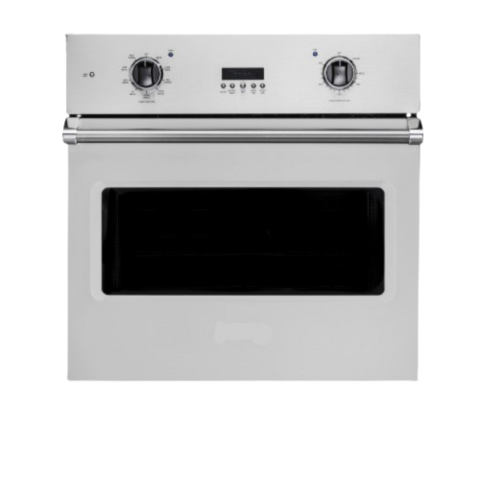
If your oven is not heating, check that the intended cavity and cooking mode were selected and the program actually started. A delayed start, control lock or showroom setting can resemble a fault on models with those features. If the settings are correct and the oven still fails to heat, it needs an assessment. This guide covers visible checks for conventional gas and electric ovens; it does not provide internal repair instructions.
Before checking controls: respond to gas or electrical warning signs
If you suspect a natural-gas leak, leave the building and make the emergency call from a safe location. Southwest Gas directs customers to call 911 and its emergency line at 877-860-6020. Do not operate appliance controls, light a flame or switch electrical devices on or off in the affected area.
This is different from an ordinary no-heat inquiry. Do not remain beside an oven to make a video of a gas odor or repeat an ignition attempt. Do not wait for an appliance-service appointment to address a suspected leak.
If there is no suspected gas leak but you see arcing, damage or a persistent burning smell, stop using the equipment and seek appropriate assistance. Do not remove an oven cover, reach behind a range or test a connection. A circuit that repeatedly trips should not be repeatedly reset.
Is there no heat, an incomplete preheat, or uneven cooking?
Use the result from the cooking attempt you already made. A control that never accepted Bake is different from a program that appeared to run without heat. Likewise, a meal browning unevenly does not establish that the oven produced no heat at all.
Identify the upper or lower cavity in a double oven. On a range, separate the oven concern from the surface burners. You do not need to start a second cavity or a broil cycle just to fill in the table; include only behavior already observed.
| Observed behavior | Helpful detail to retain |
|---|---|
| Controls respond, but the program does not begin | Selected mode, whether Start was pressed and any lock or delay indicator. |
| Preheat begins but does not appear to finish | Selected temperature, approximate elapsed time and the displayed wording. |
| One cavity or cooking mode behaves differently | Upper or lower cavity and the exact mode used during normal cooking. |
| Preheat indicates completion, but food results changed | Recipe, rack position, cookware and comparison with previous ordinary use. |
Check the selected program before suspecting components
Read the control labels and the matching owner guide. Some products require separate temperature and function selections; others require a Start command after the mode is chosen. Setting the kitchen timer does not establish that an oven program has begun.
Whirlpool's electric-oven guidance includes a fully closed door, control lock, demo mode and delayed start among the conditions to review. These features are not identical across every brand. Use the documented instruction for your panel rather than a generic combination of buttons.
Look for a rack or pan that prevents ordinary door closure once the oven is cool and safe to approach. Do not force a locked latch or dismantle the door. If the appliance was recently installed, report that history; have the installation reviewed rather than inspecting the terminal block yourself.
Keep gas, electric and dual-fuel symptoms separate
Identify the oven's energy type from the model documents if you know it. A gas cooking surface does not necessarily mean the oven uses gas: dual-fuel equipment combines different heating systems. If the type is unknown, send the model identifier instead of guessing from the appearance of the range.
Working surface burners do not prove that the oven is functioning. GE provides a separate troubleshooting topic for an electric range whose burners work while its oven does not. Record that distinction if it is already known, without treating it as proof of one failed component.
A qualified diagnosis may need to distinguish controls, heating components, sensing and power delivery. On a gas oven, ignition and gas-system work require appropriate professional assessment. This article does not tell you to inspect live wiring, relight a burner manually or replace an igniter.
Interpret preheat messages in the context of your model
Retain the exact preheat wording and the selected mode. Wolf explains that LO on the covered electric ovens is a preheating indication rather than an error. Its support also distinguishes showroom settings, incomplete door closure and a mode that was not turned on. That example should not be used to decode a different manufacturer's display.
Do not use one universal preheat time as a pass/fail test for every oven. Note the elapsed time from the attempt you already observed and compare with the product instructions. Opening the door repeatedly to feel for warmth changes the conditions and can expose you to hot surfaces.
For uneven or slow cooking, record the rack location, cookware and whether preheat had completed before the food went in. Wolf's E Series guide identifies completed preheat as important for cooking performance. If normal settings and the recommended use still produce a changed result, describe that pattern when arranging service.
Avoid resets and cleaning cycles as diagnostic experiments
Photograph a message before changing controls. Do not repeatedly cycle power, alter hidden temperature calibration or start self-clean to investigate a no-heat condition. Wolf includes no heat after self-clean among the situations covered by its support; another cleaning run is not a substitute for identifying the problem.
Do not reach into a warm oven to inspect a heating component. An element hidden behind a panel also cannot be assessed from whether you can see a glow. A visible symptom can inform a service conversation without becoming a safe parts-replacement procedure.
A combined microwave, speed oven or steam oven needs its own product guidance. The conventional-oven checks here do not establish what is appropriate for microwave components, steam generation or those appliances' special modes.
When to request oven repair in Las Vegas
Request an assessment when the correct cooking settings do not resolve the concern, a heating problem recurs or a message remains unexplained. Send the brand, accessible model, energy type if known, affected cavity, selected mode and what happened during preheat. Describe observations separately from your interpretation.
For a wall oven, show the surrounding cabinet from an ordinary standing position. For a range, mention a nearby island or a restricted approach. Leave trim, anchoring and connections intact; confirm access arrangements with the provider before anyone attempts removal.
Questions about an oven that will not heat
Why does the oven display work when there is no heat?
A responsive display confirms a control response, not successful heating. Check the program state and any documented lock or delay feature. If the oven should be heating but does not, the cause needs an assessment.
Does broil working prove the bake element has failed?
No. A difference between modes is useful information, but it does not rule out control or other electrical faults. Report the existing behavior rather than ordering a part solely from that comparison.
Should I raise the temperature to compensate for poor results?
Do not keep raising the setting to work around an unexplained change. Confirm ordinary mode and preheat instructions first, then request help if the same cooking process still behaves differently.
Sources & further reading
- Southwest Gas: home safety and suspected gas leaks
- Whirlpool: electric oven powers on but does not heat
- GE Appliances: oven does not heat but burners work
- Wolf: electric oven no-heat guidance
- Wolf: E Series oven use and care guide
This guide draws on manufacturer owner-support resources. Instructions for your specific model take precedence. Internal repairs and component diagnosis require appropriate professional assessment.
Your next step
Find the right service for your equipment.
To discuss an appliance, email [email protected] with your equipment details and observations.