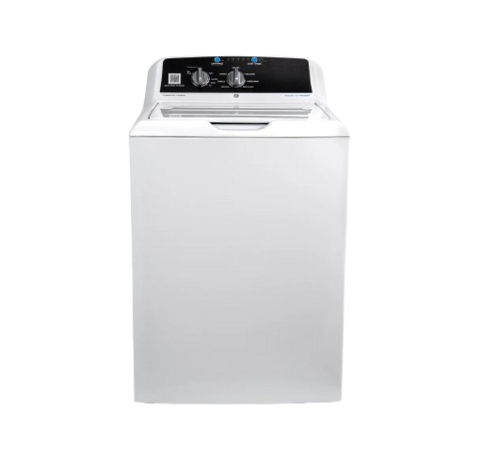
A washer that stops mid-cycle may be paused, responding to a load condition or unable to finish filling, draining or locking. Begin with the display and the last stage you observed. Check the matching owner instructions before resuming a program. If water is escaping, the machine is moving violently or there is an electrical warning sign, stop ordinary troubleshooting and seek appropriate help.
First distinguish a normal pause from an interrupted cycle
Look at the controls without repeatedly pressing Start. Is the machine displaying a paused state, an estimated time, a completion indicator or a message? A timer that appears unchanged is different from a display that has gone dark. Write down what is visible before canceling anything.
Some machines deliberately pause or extend a program. Whirlpool describes a load-balancing response in which certain top-load washers refill and move the basket to redistribute laundry. That behavior can lengthen a cycle and may end with an imbalance message if the machine cannot correct the load.
LG also documents a powered-off condition following a pause on certain washers. That is a model-specific example, not a universal four-minute rule for every appliance. Use the manual that matches the model and control panel rather than copying another brand's button sequence.
Match the interruption to fill, wash, drain or spin
Reconstruct the sequence you already saw. Did water enter? Did the basket or drum move? Was water still visible when the machine stopped? You do not need to run another load to answer. An honest gap in the timeline is more useful than a guessed description.
The table organizes a service conversation. It does not establish that a pump, inlet valve, motor or control board is faulty. Similar behavior can have more than one cause, and some cycle stages are difficult to distinguish from outside the appliance.
| Stopping point | Useful observation | Owner-level next step |
|---|---|---|
| Before water enters | Selected program, delay indicator and any inlet message | Check the control instructions; report a known household water interruption. |
| During washing or rinsing | Visible foam, load type and the exact display wording | Review the detergent and load guidance for this model. |
| Before the final spin | Whether water remains and whether a drain or imbalance message is shown | Consult that message in the matching support guide; do not force the door. |
| Display turns off | Whether the cycle had been paused and whether other power was lost | Record the sequence and any known outage instead of repeatedly restarting. |
Check the load and detergent information
Describe the actual load: a single bulky item, several towels or ordinary mixed laundry. Do not assume that a partly filled drum rules out imbalance. A load can be uneven even when the machine is not visibly full. Whirlpool's guidance associates imbalance with reduced spin speed, vibration and wet laundry.
If the manual permits redistributing a load, first follow its pause and access instructions and wait for the machine to stop and unlock normally. Never reach into a moving basket or bypass a lid switch. Stop operation if the appliance shifts from its installed position or hits nearby cabinetry.
Note the detergent type and the amount already used. LG's code guidance includes excess-suds conditions; this does not mean every mid-cycle stop is a detergent problem. Avoid adding a second dose or starting repeated wash cycles to see whether more detergent changes the result.
If water remains or the washer door stays locked
Look through the window if there is one, and describe the water you can already see. Water remaining before spin is useful information, but it does not establish whether the issue involves draining, the program state or another condition. Avoid opening a filter housing or disconnecting a hose to investigate a full machine.
LG explains that a front-load door can remain locked because of the water level, water temperature or a brief power interruption. Treat the lock as a safety feature. Do not pull harder on the handle, pry the latch or use an emergency release based on a generic online guide.
A drain-only function is appropriate only when the instructions for your exact model permit it and there is no leak or electrical concern. If you cannot identify the correct procedure, leave the door closed and ask for assistance. Do not improvise a way to empty the appliance.
Use the error message without treating it as a parts order
Photograph the characters and symbols exactly. Identify whether the message appeared on the machine or in an app. Similar-looking letters and numbers can be confused, and a message from a different product family may have a different meaning.
Use the manufacturer's support for the actual washer type. LG, for example, publishes separate guidance for front-load and top-load models. A drain-related message describes a detected condition; it does not by itself prove the drain pump needs replacement.
Keep the original message in your notes before following any documented owner procedure. Repeated resets can make your account harder to reconstruct without addressing the underlying problem. If a breaker trips again or there is a damaged cord, do not continue cycling power.
What to send with a washer repair inquiry
Summarize one interrupted load rather than sending a list of suspected parts. Include the brand, model if accessible, program, last observed stage, message and whether water remains. Explain which owner-level check you completed and what happened afterward.
For a Las Vegas visit, also describe the installation: side-by-side, stacked, in a closet or beneath a counter. A photo taken from the doorway can show access without moving the washer. Do not unstack a dryer or disconnect laundry hoses to make the space appear ready.
- Program selected and the last stage you remember.
- Exact message, visible water and normal or locked door state.
- Load type and detergent already used.
- Whether this has happened once or across separate ordinary loads.
- Accessible model label and a photo of the laundry-space layout.
Common questions about a washer stopping mid-cycle
Why does the washer stop before spinning?
The timing can fit an imbalance response, a drainage condition or another interruption. Note whether water remains and whether the display gives a message. The stopping point helps narrow the assessment but cannot identify a failed part on its own.
Should I restart the whole wash program?
Follow the owner guide for the displayed state first. Restarting can add another fill or detergent dose and may repeat the interruption. Do not restart if the machine is leaking or showing an electrical problem.
Is a locked door proof the lock is broken?
No. A lock can stay engaged as part of normal protection while water is hot or at an unsafe level. Use the correct model instructions and seek help if the door will not release normally.
Sources & further reading
- Whirlpool: top-load washer stops mid-cycle
- LG: washer powered off during a cycle
- LG: front-load washer error-code list
- LG: recovering from a locked washer
- LG: top-load washer error-code list
This guide draws on manufacturer owner-support resources. Instructions for your specific model take precedence. Internal repairs and component diagnosis require appropriate professional assessment.
Your next step
Find the right service for your equipment.
To discuss an appliance, email [email protected] with your equipment details and observations.